10. The iSWAP Gate in Superconducting Qubits
This section of the notes is inspired from Jonathan’s Home Quantum Inofrmation Processing II: Implementations lecture script.
We will discuss how we can implement two-qubit gates in superconducting circuits. We have seen how, in trapped ions, a bi-chromatic drive inducing JC and anti-JC interactions led to the Mølmer-Sørensen gate. Sadly, anti-JC interactions are not readily available in superconducting qubits, and we will need to be more creative.
The trick, once again, is to consider the dispersive limit of the qubit 1, qubit 2 and cavity system. To see this, we write down the Hamiltonian of the full system
\[\hat{H} = \hat{H}_0 + \hat{H}_1\]with
\[\begin{align*} \hat{H}_0 &= \frac{\hbar\omega_{eg}}{2}\left(\hat{\sigma}_z^{(1)} + \hat{\sigma}_z^{(2)}\right) + \hbar\omega_c\,\hat{a}^\dagger\hat{a} \\ \hat{H}_1 &= \hbar g \left(\hat{a}^\dagger\hat{\sigma}_-^{(1)} + \hat{a}\hat{\sigma}_+^{(1)}\right) + \hbar g \left(\hat{a}^\dagger\hat{\sigma}_-^{(2)} + \hat{a}\hat{\sigma}_+^{(2)}\right) \end{align*}\]where the second term, represents the interaction between the cavity mode and the qubits (note the JC-structure). We would like to have some sort of direct interaction term between qubit 1 and 2. In operator terms, this would look someting like $\hat{\sigma}^{(1)}_+\hat{\sigma}^{(2)}_- + \text{h.c.}$ As previously mentioned, we can try to look at our Hamiltonian in the dispersive limit, namely $g \ll \Delta\omega = \omega_{eg} - \omega_c$. Once again, we will perform the Schrieffer-Wolff transform, namely
\[\hat{H} \to e^{-\hat{S}}\hat{H}e^{\hat{S}}\]And chosing $\hat{S}$ such that the following identity is true
\[\left[\hat{S}, \hat{H}_0\right] = -\hat{H}_1\]This then allows us to write the transformed Hamiltonian as
\[\begin{align*} \hat{H} \to e^{-\hat{S}}\hat{H}e^{\hat{S}} &= \hat{H} + [\hat{S}, \hat{H}] + \frac{1}{2}[\hat{S}, [\hat{S}, \hat{H}]] + \dots \\ &=\hat{H}_0 + [\hat{S}, \hat{H}_1] - \frac{1}{2}[\hat{S}, \hat{H}_1] +\frac{1}{2}[\hat{S}, [\hat{S}, \hat{H}_1]] + \dots \\ &= \hat{H}_0 + \frac{1}{2}[\hat{S}, \hat{H}_1] + O(\hat{V}^3) \end{align*}\]It is not trivial to find a suitable $\hat{S}$, but for this case, one can check that the following works
\[\hat{S}=\frac{g}{\Delta\omega}\sum_{i=1,2} \left(\hat{a}^\dagger\hat{\sigma}_-^{(i)} - \hat{a}\hat{\sigma}_+^{(i)}\right)\]We can then plug $\hat{S}$ into the equation above to get the transformed Hamiltonian
\[\hat{H} \approx \frac{\hbar\omega_n}{2}\left(\hat{\sigma}_z^{(1)} + \hat{\sigma}_z^{(2)}\right) + \frac{g^2}{2\Delta\omega}\left(\hat{\sigma}_+^{(1)}\hat{\sigma}_-^{(2)} + \hat{\sigma}_-^{(1)}\hat{\sigma}_+^{(2)}\right)\]Where $\omega_n$ is the qubit energy splitting modified by the bosonic mode due to the dispersive interaction:
\[\omega_n \approx \omega_{eg} - \frac{g^2}{\Delta\omega}\left(1 + 2\,\hat{a}^\dagger\hat{a}\right)\]Let’s concentrate on the second term, since it is more interesting. We note that
\[\hat{\sigma}_x^{(1)}\hat{\sigma}_x^{(2)} + \hat{\sigma}_y^{(1)}\hat{\sigma}_y^{(2)} = 2\left(\hat{\sigma}_+^{(1)}\hat{\sigma}_-^{(2)} + \hat{\sigma}_-^{(1)}\hat{\sigma}_+^{(2)}\right)\]Thus the Hamiltonian that we have obtained, yields to interactions that are similar to that of the MS gate in trapped ions. To see the action of the gate, we can compute its propagator
\[\hat{U}(t) = e^{-\frac{i\hat{H}t}{\hbar}}\]Then setting $\theta = g^2t/2\Delta\omega$, we get
\[\hat{U}(\theta) = \begin{pmatrix} 1 & 0 & 0 & 0 \\ 0 & \cos\theta & i\sin\theta & 0 \\ 0 & i\sin\theta & \cos\theta & 0 \\ 0 & 0 & 0 & 1 \end{pmatrix}\]If we set $\theta=\pi/2$, we obtain the $i\text{SWAP}$ gate, whose action is to swap $\vert 10\rangle$ and $\vert 01\rangle$ states while acquiring a phase $i$, namely
\[\begin{align*} i\text{SWAP}\left(\vert{00}\rangle\right) &= \vert{00}\rangle \\ i\text{SWAP}\left(\vert{01}\rangle\right) &= i\vert{10}\rangle \\ i\text{SWAP}\left(\vert{10}\rangle\right) &= i\vert{01}\rangle \\ i\text{SWAP}\left(\vert{11}\rangle\right) &= \vert{11}\rangle \end{align*}\]As usual, one can combine $i\text{SWAP}$ gates together with single-qubit rotations to implement a $CNOT$ gate.
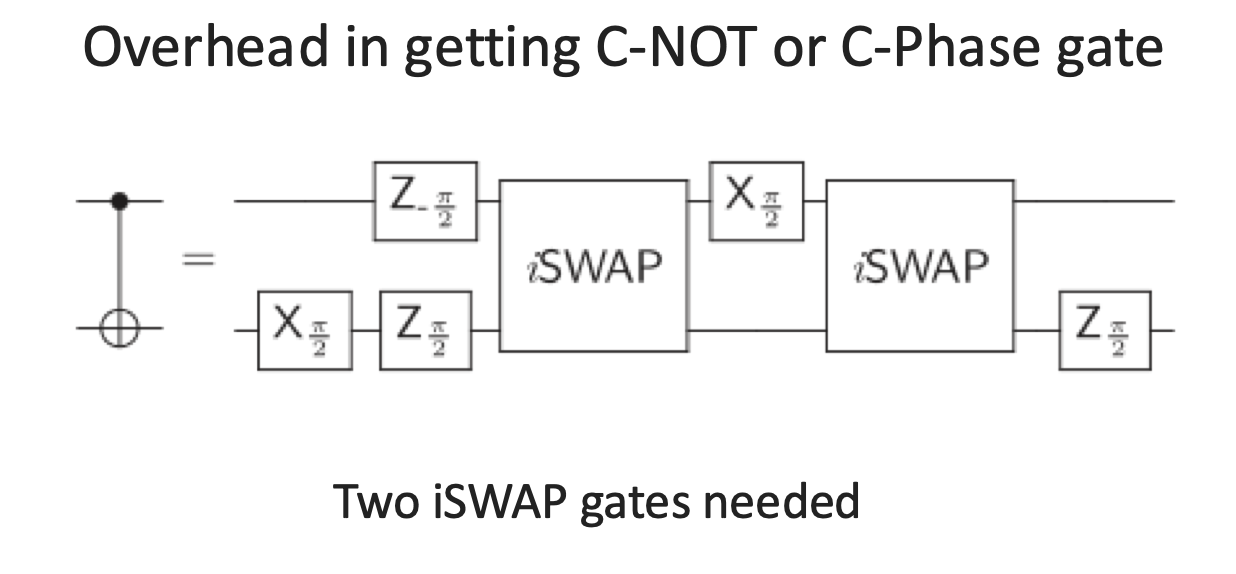
The Direct-Coupling CZ Gate
The issue of the $i\text{SWAP}$ gate is that it introduces a significant overhead to implement the standard $CNOT$ gate. This can be seein in the diagram above. Therefore, other methods have been proposed to implement a two-qubit gate in superconducting circuits. This has been proposed by Strauch et al.. Here is a general outline. Two qubits are directly capacitatively coupled:
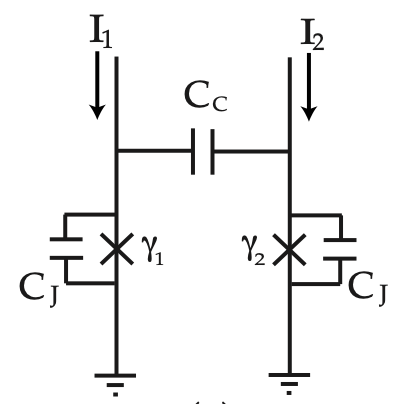
One disadvantage here is that interacting qubits now need to be neighbor for the capacitive interaction to occur. We assume that we can tune the frequency of the two qubits with control lines, by applying an external flux difference. Thus we obtain a unitary operator of the form
\[\hat{U} = \begin{pmatrix} 1 & 0 & 0 & 0 \\ 0 & e^{i\int\delta\omega_{01}(\tau)\mathrm{d}\tau} & 0 & 0 \\0 & 0 & e^{i\int\delta\omega_{10}(\tau)\mathrm{d}\tau} & 0 \\ 0 & 0 & 0 & e^{i\int\delta\omega_{11}(\tau)\mathrm{d}\tau} \end{pmatrix}\]Therefore, we can sweep the detunings $\delta\omega_{ij}(t)$ to acquire state-dependent phases. The idea is that avoided zero-crossings, one can deviate from $\delta\omega_{11} = \delta\omega_{10} + \delta\omega_{01}$, thus allowing us to engineer the wanted interactions.