7. Two-Qubit Gates in Trapped Ions
If we want to run two quibt gates, we need some sort Hamiltonian that couples different qubits in our quantum computer. We have seen how, in the case of neutral atom platforms, strong dipole-dipole interactions are native to the system and thus can be directly used to implement this inter-qubit coupling.
In contrast, trapped ion direct spin-spin interactions are very weak and do not allow for practical implementation of two-qubit gates. The solution was given by Cirac and Zoller. The shared motional modes are then used as a quantum bus to transfer information from one ion to the other.
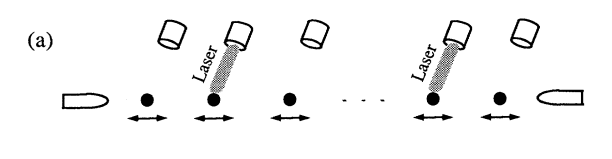
The Shared Motional Modes
Let us now study the motional modes of the ion chain. We will see that, it will be beneficial to consider uncoupled normal modes. To this end, we consider a chain of ions confined in one direction (we could either consider the static DC axial field or the pseudopotantial on the radial directions due to RF). The total potential of the chain is given by:
\[V = \underbrace{\sum_{\alpha=1}^N \frac{1}{2} m \omega^2 x_\alpha^2(t)}_\text{kinetic term} + \underbrace{\sum_{\alpha = 1}^N\sum_{\alpha^\prime = 1}^N \frac{Z^2 e^2}{8\pi\varepsilon_0} \frac{1}{x_\alpha(t) - x_{\alpha^\prime}(t)}}_\text{electrostatic term}.\]First, we can compute the equilibrium position of the ions within the chain $x_\alpha^{(0)}$ by evaluating
\[\frac{\partial V}{\partial x_\alpha} \bigg\vert_{x_\alpha = x_\alpha^{(0)}} = 0.\]If we go through the algebra, we find a set of coupled equations, namely
\[u_\alpha - \sum_{n = 1}^{m - 1}\frac{1}{(u_m - u_n)^2} + \sum_{n = m + 1}^{N}\frac{1}{(u_m - u_n)^2} = 0, \ \text{with} \ m = 1,2,\dots,N\]where we have introduced the length scale as
\[l = \left(\frac{Z^2 e^2}{4\pi\varepsilon_0 m \omega^2}\right)^\frac{1}{3},\]We can then analytically solve and, for example, we have the following for $N=30$ ions
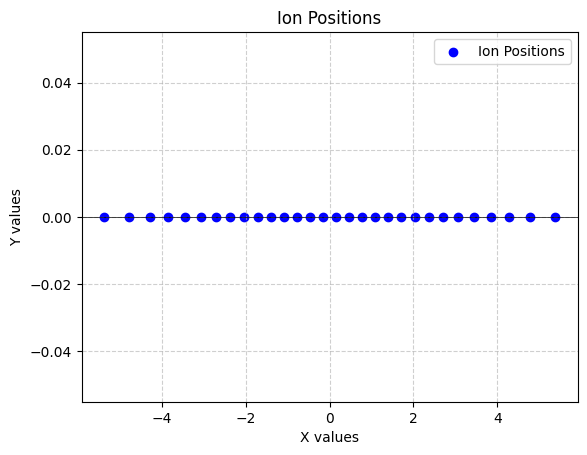
Notice the inhomogeneous spcing that arises from the hamrmonic potential. Now that we have the center position of all the ions, we can linearize the lagrangian around this point as
\[L = \sum_{m = 1}^N\frac{1}{2}m_m \dot{q}_m^2 - \sum_{n = 1}^N\sum_{m = 1}^N\frac{1}{2}q_n q_m \frac{\partial^2V}{\partial x_n \partial x_m}\Big\rvert_{q_n, q_m = 0}.\]Where we have introduced the normalised ion location $q_\alpha = x_\alpha - x_\alpha^{(0)}$. Note that the potential is expanded around the equilibrium position.
We can rewrite the expression above in terms of the matrix $A$ (having entries $A_{nm}$) as
\[L = \frac{1}{2}\left[\sum_{m = 1}^N m_m \dot{q}_m^2 - \omega^2 \sum_{n = 1}^N\sum_{m = 1}^N A_{nm}q_n q_m\right],\]The eigenvectors of $A$ are defined to be the normal modes of the system and tell us about the oscillation direction. While its eigenvalues are related to the frequencies of each normal mode
Here is what we can expect in the case of two and three ions 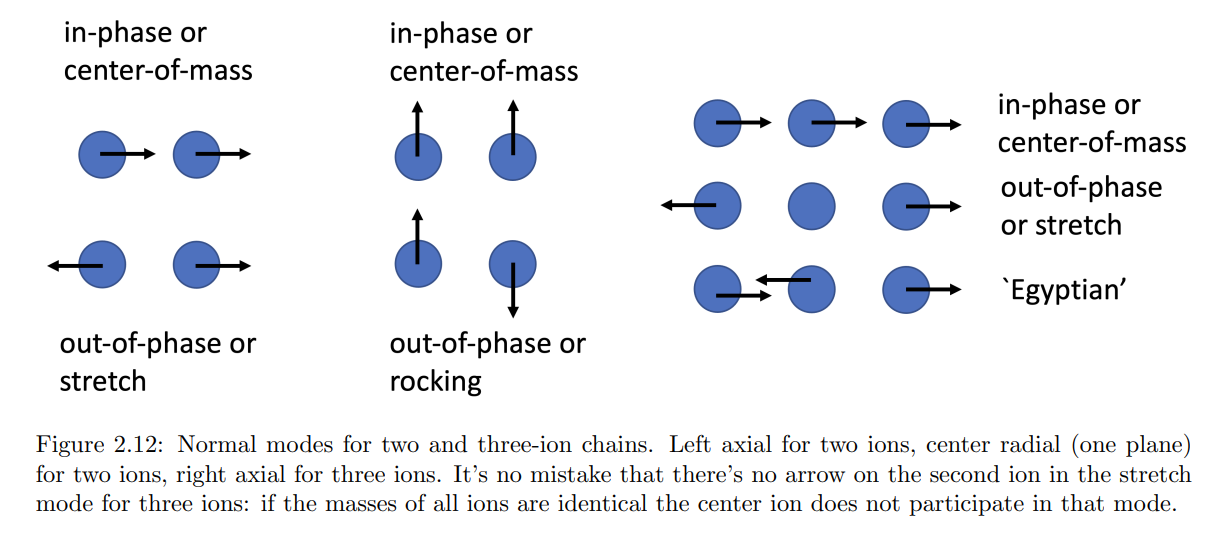
And here is the computation for two ions.
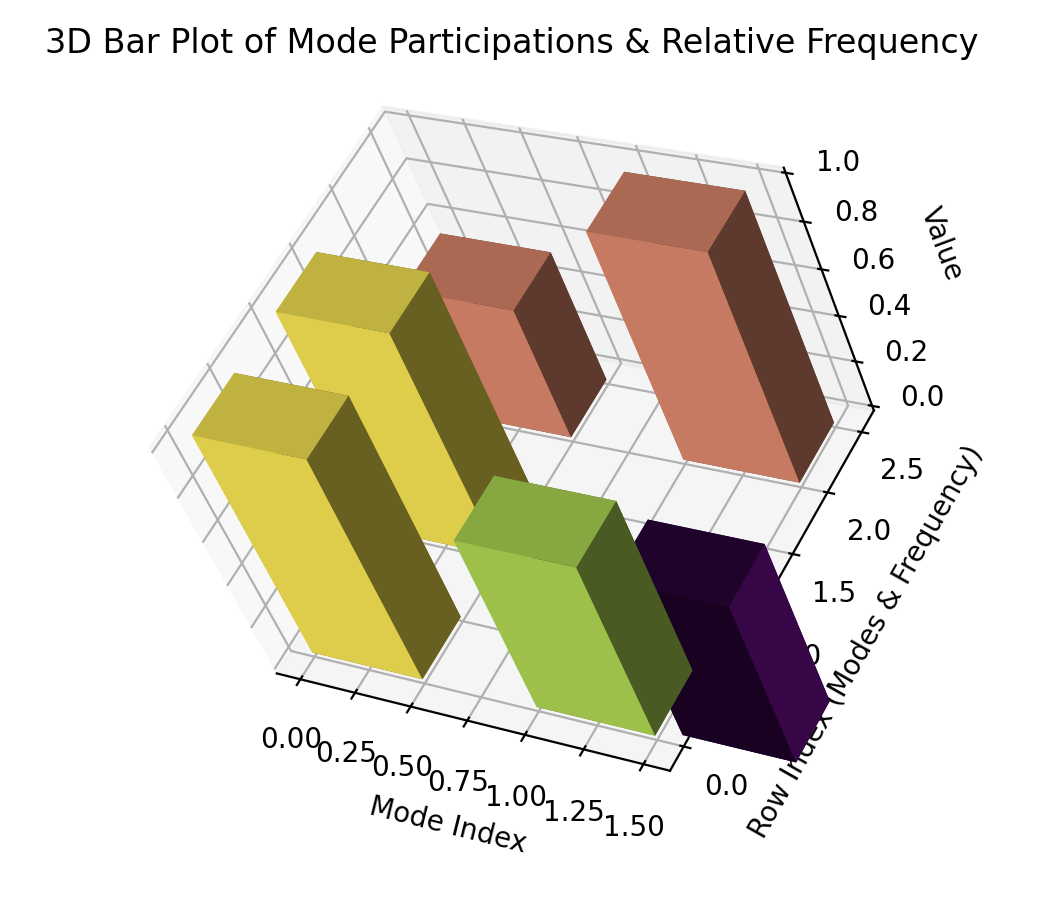
The thing to note is that now, through the concept of normal modes, the motion is shared across different ions. This is what will enable us to create synthetic spin-spin coupling, using normal modes as quantum buses.
The Cirac-Zoller Gate
The Cirac-Zoller gate implements the so called controlled-z $CZ$ gate, defined as follows
\[\hat{U}_{CZ} = \begin{pmatrix} 1 & 0 & 0 & 0 \\ 0 & 1 & 0 & 0 \\ 0 & 0 & 1 & 0 \\ 0 & 0 & 0 & -1 \end{pmatrix}\]We see that the effect is to introduce a phase factor of $180^\circ$ on the state $\vert e_1 e_2\rangle$ only. We will see later how this can be converted to a $CNOT$.
For now, let’s consider three levels $\vert g\rangle$, $\vert e\rangle$ and an auxiliary state $\vert A\rangle$. Here are the steps of the gate
- The initial state of the full system is
-
Transfer spin 1 into motion using RSB π pulse on ion 1 $\vert g_1, n\rangle \leftrightarrow \vert e_1, n-1\rangle$:
\(\vert \psi_1\rangle = \vert g_1\rangle (-i\alpha \vert 1\rangle + \beta \vert 0\rangle)(\gamma \vert e_2\rangle + \delta \vert g_2\rangle)\) -
To get a -1 phase perform (2\pi) rotation on red sideband of auxiliary transition of ion two $\vert g_2, n\rangle \leftrightarrow \vert A_2, n-1\rangle$:
- Transfer motion back to spin 1 with RSB π pulse on ion 1:
We see that the action is indeed the one of $\hat{U}_{CZ}$. In fact
\[\vert{\psi_0^q}\rangle = \alpha \gamma \vert e_1\rangle \vert e_2\rangle + \alpha \delta \vert e_1\rangle \vert g_2\rangle + \beta \gamma \vert g_1\rangle \vert e_2\rangle + \beta \delta \vert g_1\rangle \vert g_2\rangle\]and
\[\hat{U}_{CZ} \vert{\psi_0^q}\rangle = \vert{\psi_3^q}\rangle\]From CZ to CNOT
In order to go from the action of a $CZ$ to a $CNOT$, which is what we usually think about, we can apply Hadamard gates to the second qubit before and after, such that the action of $Z$ and $X$ are swapped, namely
\[\hat{U}_{CNOT} = (\mathbb{I} \,\otimes\, \hat{H}) \hat{U}_{CZ} (\mathbb{I} \,\otimes\, \hat{H})\]Limitations of the Cirac-Zoller Gate
We notice that at the end of the operation, the motion and qubit degrees of freedom are not entangled anymore. This is a good thing, since if they were, any motional dephasing would affect the quantum information present in the qubits.
A fundamental limitation of the Cirac-Zoller gate is however its reliance on the motional ground state initialisation. Any population present in the non-zero fock state, will limit the fidelity
Mølmer-Sørensen Gate
The way to improve on the Cirac-Zoller limitation on the motional mode preparation is given by the Mølmer-Sørensen (MS) gate. The core idea of the MS gate is to apply a state-dependent force (SDF) on both ion spin states. To this end, the ions are illuminated with bi-chromatic light having freqencies
\[\omega = \omega_{el} \pm (\omega_m + \delta)\]where $\delta$ is the detuning from the RSB and the BSB. In other words, we are drived both a RSB and a BSB at the same time, with the same detuning. We can calculate the time evolution of this Hamiltoninan, resulting in
\[\begin{align*} \hat{U}_{\text{MS}}(t) &= \hat{D}\left[\alpha(t)(\hat{\sigma}_x \otimes \mathbb{1} + \mathbb{1} \otimes \hat{\sigma}_x)\right] e^{-i2\beta(t)(\mathbb{1}\otimes\mathbb{1}+\hat{\sigma}_x \otimes \hat{\sigma}_x)} \\ \alpha(t) &= -\frac{i\Omega}{\delta} e^{-i\delta t/2} \sin(\delta t/2)\\ \beta(t) &= \left(\frac{\Omega}{2\delta}\right)^2 (\delta t - \sin(\delta t)) \end{align*}\]where $\Omega = \Omega_{RSB}/\Omega_{BSB}$ is the ratio between the driving strength (rabi rate) of the RSB and BSB tones. If we work in the $\vert\pm_1\pm_2\rangle$ basis, we see that the MS gate only acts on states where both ions have the same spin state, namely $\vert ++\rangle$ and $\vert –\rangle$.
As we do not want any spin-motion entangnelement, we want to chose the gate time $t$ such that $\alpha(t) = 0$. This results in
\[\beta = \frac{\pi}{2}\left(\frac{\Omega}{\delta}\right)^2\]The phase change for the $\vert ++\rangle$ and $\vert –\rangle$ states is given by
\[\phi = -2\pi\left(\frac{\Omega}{\delta}\right)^2\]Thus we can chose $\Omega = \delta / 2$ to get $\phi = \pi /2$. Thus the action in the $x$ ($\vert\pm_1\pm_2\rangle$) basis is
\[\begin{align*} \hat{U}_{\text{MS}} |+1, +2, n\rangle &\to -i |+1, +2, n\rangle \\ \hat{U}_{\text{MS}} |+1, -2, n\rangle &\to |+1, -2, n\rangle \\ \hat{U}_{\text{MS}} |-1, +2, n\rangle &\to |-1, +2, n\rangle \\ \hat{U}_{\text{MS}} |-1, -2, n\rangle &\to -i |-1, -2, n\rangle \end{align*}\]And in matrix form, it equates to
\[\hat{U}_{MS} = \begin{pmatrix} -i & 0 & 0 & 0 \\ 0 & 1 & 0 & 0 \\ 0 & 0 & 1 & 0 \\ 0 & 0 & 0 & -i \end{pmatrix}\]We can express $\hat{U}_{MS}$ in the $z$-basis as follows
\[\hat{U}_{MS} = \frac{1}{\sqrt{2}} e^{i\pi/4} \begin{pmatrix} 1 & 0 & 0 & 1 \\ 0 & 1 & -i & 0 \\ 0 & -i & 1 & 0 \\ 1 & 0 & 0 & 1 \end{pmatrix}\]where we immediately see that we obtain an entangling gate. Once again, with the help of single-qubit rotations, we can restore the $CNOT$ action.